



There’s a moment on the Snæfellsnes Peninsula when the road bends, the sky opens up, and you realize you’ve stopped trying to “see everything.” You’re just there, watching the wind push across lava fields while the Atlantic crashes somewhere out of sight.
That’s kind of the point of this place.
Snæfellsnes is often called “Iceland in miniature,” which sounds like a tourism slogan—but it’s not wrong. Volcanoes, black sand beaches, fishing villages, cliffs, glaciers… it’s all here. The difference is, it doesn’t feel staged. It feels lived-in, weathered, and a little unpredictable.
And if you’re deciding whether it’s worth carving out time for, the short answer is yes. But only if you’re willing to slow down and let it unfold.
The Road That Doesn’t Rush You
Driving the peninsula isn’t about ticking off stops. It’s about the space between them.
The main loop, Route 54, wraps around the region in a way that almost invites you to take wrong turns. You’ll see a gravel road and think, “Maybe just five minutes.” Then suddenly you’re parked near a quiet inlet with no one else around, wondering why this wasn’t on any list.
That’s Snæfellsnes.
The distances are manageable—you can technically do it in a day from Reykjavík—but squeezing it into a rushed itinerary misses the point. Stay a night if you can. Two is better. The light alone changes everything. Morning fog rolls off the ocean, then disappears by noon, and by evening the whole coastline turns gold.
It’s not dramatic in a loud way. It’s subtle, and it builds on you.
Snæfellsjökull: The Quiet Centerpiece
You’ll see it before you realize what you’re looking at.
Snæfellsjökull glacier rises at the western tip of the peninsula, often wrapped in clouds like it’s hiding on purpose. On clear days, it looks almost too perfect—white ice sitting on top of a dark volcanic cone, straight out of a novel. Which, interestingly, it is. Jules Verne used it as the entrance to the center of the Earth.
That detail somehow fits. The place has that kind of energy.
If you’re thinking of hiking or getting closer, the weather decides everything. One minute it’s clear, the next it’s gone. Local guides don’t mess around with conditions here, and you shouldn’t either. But even from a distance, it anchors the entire peninsula. Wherever you go, it’s there, watching.
Small Towns That Don’t Perform
There are towns along the peninsula, but they don’t exist to entertain you.
Stykkishólmur is probably the most “lively,” with a working harbor, a few good restaurants, and a calm rhythm that feels authentic rather than curated. You might grab a bowl of seafood soup, sit by the water, and watch locals go about their day. No one’s in a hurry. It’s not that kind of place.
Then there’s Arnarstapi and Hellnar—tiny coastal villages connected by a walking path that hugs the cliffs. You’ll see seabirds nesting in impossible places, waves carving into rock arches, and maybe a couple quietly taking photos without saying much.
It’s not silence, exactly. It’s just the absence of noise that doesn’t belong.
Kirkjufell: The Mountain You’ve Already Seen
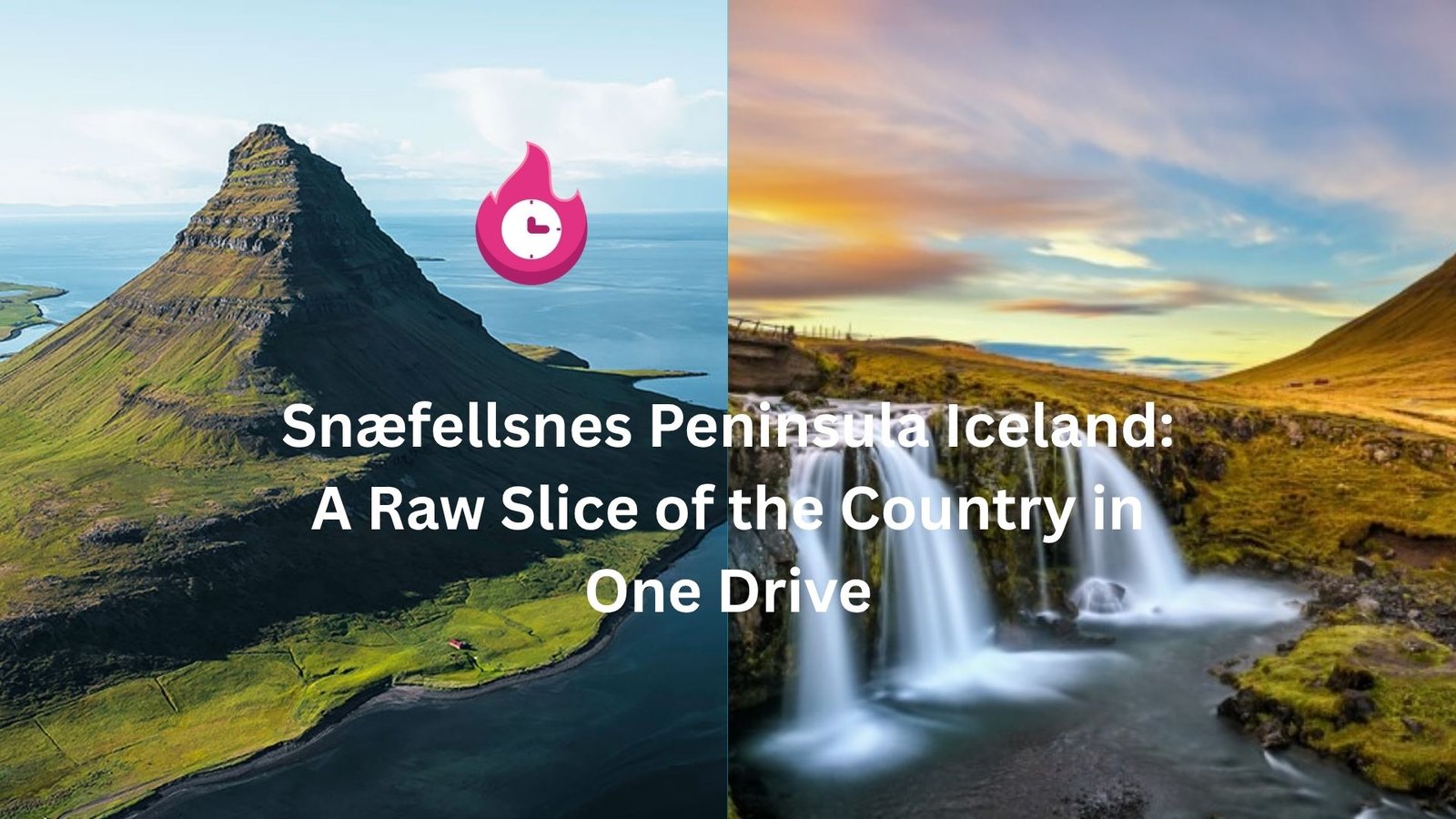
Even if you don’t think you know Kirkjufell, you probably do.
It’s that arrow-shaped mountain near a small waterfall—one of the most photographed spots in Iceland. And yes, it’s popular. You won’t have it to yourself unless you show up at odd hours.
But here’s the thing: it still feels worth it.
There’s a moment when the light hits just right, the water flows in the foreground, and the mountain stands perfectly still behind it. You’ll see people adjusting tripods, stepping carefully across wet rocks, trying to frame the shot. And then, almost unconsciously, everyone pauses at the same time.
Because it’s not just photogenic. It’s strangely calming.
If you want a quieter version, walk a bit further away from the main viewpoint. The mountain changes shape depending on where you stand, and the crowds thin out fast once you move off the obvious path.
Beaches That Feel Untouched
The southern coast of the peninsula is rougher, more exposed. The beaches here don’t invite you to relax—they make you pay attention.
Djupalonssandur is a standout. Black pebbles, scattered remnants of a shipwreck, and waves that hit harder than they look. There are lifting stones on the beach once used to test fishermen’s strength. You’ll probably try one, even if you know it’s a bit cliché.
And you might fail. Most people do.
Nearby, there’s a short walk through lava fields to reach the shore. The path twists through jagged formations that look like they cooled mid-explosion. It’s not hard, but it feels otherworldly, like stepping through something unfinished.
You don’t linger here the way you would on a sunny beach. You move, stop, watch, and move again.
Wildlife Moments You Don’t Plan
One of the best parts of Snæfellsnes is how often something unexpected happens.
You might be driving along the coast and spot seals stretched out on rocks, barely moving except for the occasional head lift. Ytri Tunga beach is known for this, but honestly, you don’t need a “known spot.” Keep your eyes open and you’ll find them.
Birdlife is everywhere, especially near cliffs. In summer, puffins nest along the edges, and if you’re patient, you’ll catch them waddling awkwardly before launching into the air.
There’s no schedule for this. No guarantees. That’s what makes it better when it happens.
Weather That Keeps You Honest
Let’s be honest: the weather here doesn’t care about your plans.
You can wake up to sunshine, drive ten minutes, and hit sideways rain. Then it clears again. Layers aren’t optional—they’re survival tools. Windproof jackets, good shoes, and a willingness to adapt will make or break your experience.
But the shifting weather is part of the character. A cloudy sky over lava fields feels different from a bright one. It adds depth, texture, mood. You start to see why locals don’t talk about “bad weather” the same way visitors do.
It’s just weather.
Food That Matches the Place
You won’t find flashy dining here, and that’s a good thing.
Think fresh fish, simple preparation, warm soups, and bread that actually tastes like something. In small towns, meals feel grounded—like they belong to the place rather than trying to impress you.
There’s a kind of quiet satisfaction in sitting down after a long, windy walk and eating something straightforward and good. No big reveal. No performance. Just food that does its job.
And sometimes that’s exactly what you want.
When to Go (And When Not To)
Summer brings long days and easier driving conditions. You’ll have more access, more light, and more people. It’s a trade-off.
Winter is a different experience entirely. Snow reshapes the landscape, roads can close, and daylight shrinks. But if you’re prepared, it’s incredibly atmospheric. Fewer crowds, softer light, and the chance—never guaranteed—of seeing the northern lights.
Shoulder seasons might be the sweet spot. Spring and fall give you space without completely unpredictable conditions. You’ll still need flexibility, but you won’t feel like you’re sharing every viewpoint.
The Subtle Shift It Creates
There’s something about Snæfellsnes that doesn’t fully hit you until after you leave.
Maybe it’s the slower pace, or the way the landscape never tries too hard to impress you. It just exists, and you meet it halfway. You stop checking your phone as often. You notice small things—a shift in light, a change in wind, the sound of waves hitting rock at different angles.
It recalibrates your attention without announcing it.
And when you’re back in a busier place, you’ll catch yourself thinking about a random stretch of road, or a quiet harbor, or that moment when the glacier finally came into view.
Not because it was dramatic.
Because it felt real.
The Takeaway
Snæfellsnes Peninsula isn’t about highlights—it’s about texture.
You go for the landscapes, sure, but you stay for the feeling of moving through a place that hasn’t been overly shaped for visitors. It asks a little more from you: time, patience, attention.
Give it that, and it gives something back that’s harder to describe than a checklist of sights.
And that’s usually the kind of place worth going out of your way for.
