



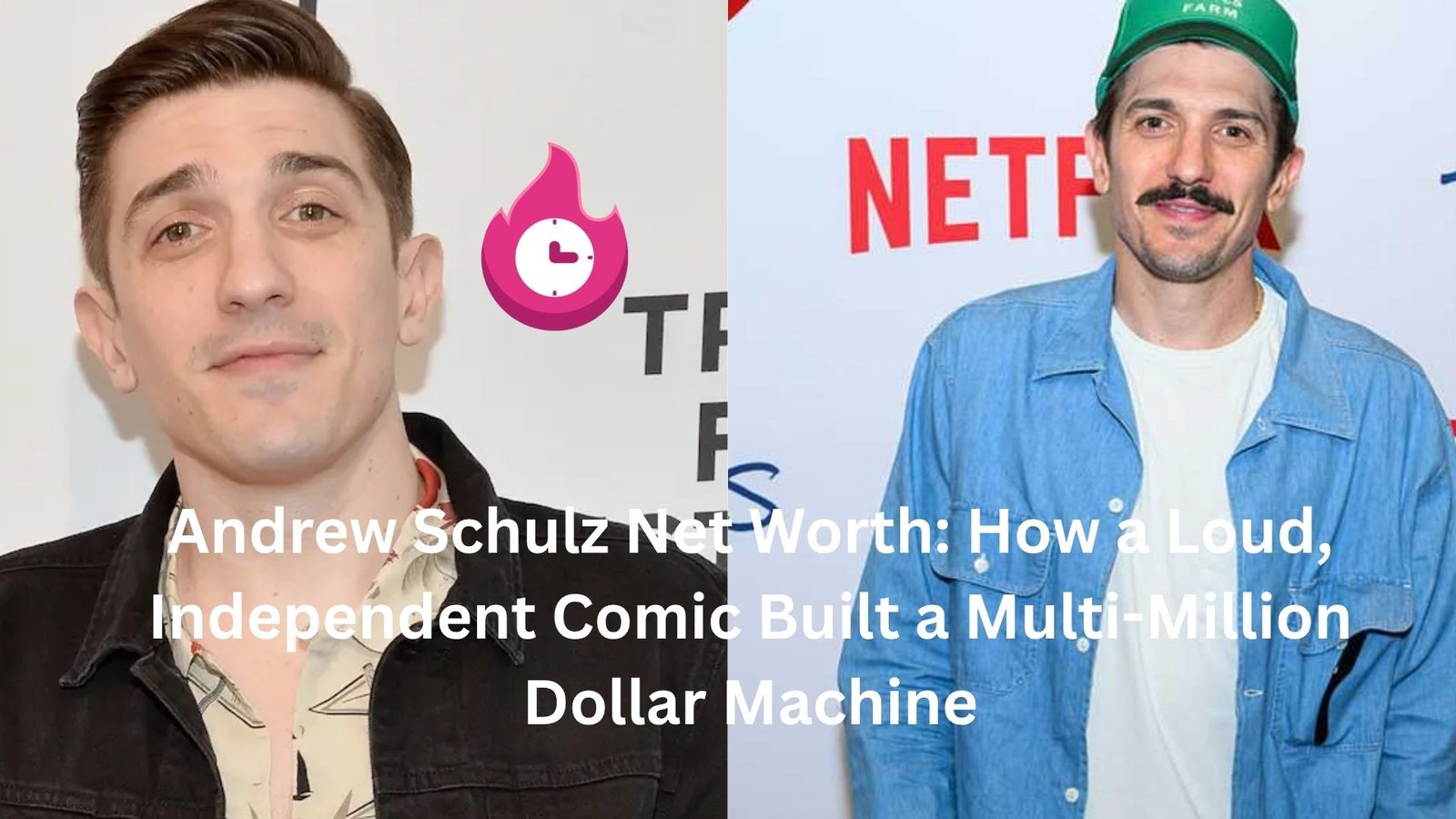
Andrew Schulz didn’t take the traditional path to success. No slow climb through network sitcoms. No waiting around for Hollywood to hand him permission. He built his audience in public, online, and often in defiance of the industry that usually controls comedians.
That approach didn’t just shape his career—it shaped his bank account too.
So what’s Andrew Schulz’s net worth today? Estimates generally land somewhere between $8 million and $12 million, depending on how you value his business ventures, touring revenue, and media deals. But that number only tells part of the story. The interesting part is how he got there—and why his model might matter more than the number itself.
The Early Grind Wasn’t Glamorous
Before the sold-out theaters and Netflix buzz, Schulz was doing what most comedians do: grinding in small clubs, testing jokes in front of half-interested crowds, and trying to get noticed.
He appeared on shows like Guy Code on MTV2, which gave him some visibility. But let’s be honest—being “that guy from MTV2” doesn’t automatically translate into wealth. It’s exposure, not ownership.
At that stage, most comedians are stuck waiting. Waiting for a late-night spot. Waiting for a network deal. Waiting for someone else to decide they’re valuable.
Schulz didn’t love that setup.
YouTube Changed Everything
Here’s where things start to get interesting.
Instead of chasing traditional gatekeepers, Schulz leaned hard into YouTube. He began releasing short stand-up clips—tight, punchy, and tailored for online attention spans. Not full specials. Just jokes that hit fast.
This wasn’t common at the time. Most comics guarded their material like it was gold. Schulz treated it more like fuel—burn it, get attention, repeat.
And it worked.
Clips started racking up millions of views. Suddenly, he wasn’t just another comic hoping for a break—he had an audience that showed up for him directly.
That shift matters financially. A loyal audience means ticket sales. It means leverage. It means you’re no longer asking for opportunities—you’re creating them.
Touring: The Real Money Engine
Let’s be real about where comedians actually make money: touring.
Streaming platforms might pay a flat fee. TV pays exposure. But live shows? That’s where the serious income kicks in.
Schulz turned his online following into packed venues across the U.S. and internationally. And because he built his audience independently, he kept more control over pricing, promotion, and distribution.
Imagine two comedians:
- One gets booked by a network-backed tour and takes a cut.
- The other sells directly to fans who already know and trust him.
Schulz is the second guy.
Ticket sales, merchandise, VIP packages—it adds up quickly. A successful tour can generate millions, especially when you’re consistently selling out.
The Podcast Play: “Flagrant” and Beyond
Podcasts are another major piece of Schulz’s income puzzle.
His show Flagrant (formerly Flagrant 2) isn’t just a side project—it’s a business. Between ad revenue, YouTube monetization, sponsorships, and premium content, podcasts can quietly become cash machines.
But it’s not just about the money. Podcasts deepen audience loyalty. You’re not just a comedian telling jokes—you’re a personality people spend hours with every week.
That kind of connection turns casual fans into repeat buyers. The person who laughs at your podcast today might buy a $75 ticket tomorrow without thinking twice.
Schulz understood that early.
The Netflix Move—On His Terms
Here’s a moment that says a lot about his mindset.
When Schulz released his special Infamous, he initially distributed it independently through his own website. Fans could buy it directly. No middleman. No platform dictating terms.
Only later did it land on Netflix.
That sequence matters. He proved he didn’t need Netflix—Netflix was just an amplifier.
Financially, that’s powerful. Instead of accepting whatever deal is offered, you negotiate from strength. Or you skip the deal entirely.
Either way, you keep more of the upside.
Multiple Income Streams, One Brand
If you try to pin Schulz’s net worth to a single income source, you’ll miss the point.
His money comes from a mix of:
- Live touring revenue
- YouTube monetization
- Podcast ads and sponsorships
- Merchandise
- Streaming deals
- Direct-to-consumer content sales
None of these alone explains his wealth. Together, they create something more stable—and more scalable.
It’s a bit like owning several small businesses that all feed into the same brand. If one slows down, the others keep things moving.
Why His Strategy Works (And Most People Miss It)
Here’s the thing: Schulz didn’t just chase fame—he chased control.
A lot of entertainers optimize for visibility. They want the biggest platform, the biggest audience, the fastest rise.
But visibility without ownership is fragile.
Schulz flipped that. He built his own distribution first, then layered on mainstream exposure later. It’s slower at the start, but it compounds.
Think of it like this:
Would you rather have a million followers you don’t control, or 200,000 fans who will actually pay you directly?
Schulz chose the second path—and that’s why his net worth reflects more than just popularity.
Controversy, Risk, and Reward
It’s worth noting that Schulz’s style isn’t exactly safe. He pushes boundaries, says things that spark debate, and doesn’t always play by industry rules.
That comes with risk. You can lose deals. You can alienate parts of an audience.
But it also strengthens his core fan base. People who like Schulz tend to really like him. And that kind of loyalty translates into financial support.
There’s a difference between being widely liked and deeply supported. Schulz leans into the second.
Comparing Him to Traditional Comics
If you look at older comedy models, the path was clearer:
Get on late-night → land a sitcom → release specials → tour
It worked, but it depended heavily on gatekeepers.
Schulz’s path looks more like this:
Build audience online → monetize directly → expand into mainstream → retain ownership
Both paths can lead to wealth. But the second one gives you more control over how that wealth is built—and kept.
Lifestyle: Flashy or Focused?
Despite his success, Schulz doesn’t come across as someone trying to flaunt extreme wealth.
Sure, he lives well. Nice clothes, travel, production quality. But he’s not known for over-the-top spending in the way some entertainers are.
That matters more than people think.
Net worth isn’t just about what you earn—it’s about what you keep. And creators who reinvest into their brand often end up growing their wealth faster than those who treat income like a finish line.
What His Net Worth Really Represents
So yes, Andrew Schulz’s net worth sits comfortably in the multi-million range.
But the number itself isn’t the most interesting part.
What matters is what it represents:
- Independence over reliance
- Audience ownership over platform dependency
- Consistency over one big break
He didn’t wait for the industry to validate him. He built something that made validation optional.
That’s a very different kind of success.
The Takeaway
Andrew Schulz’s net worth is the result of a strategy that feels obvious in hindsight but was far from standard when he started.
He bet on himself. He bet on the internet. And he bet on the idea that if you build a real audience, the money will follow.
And it did.
If there’s one thing to take from his story, it’s this: the fastest path isn’t always the strongest one. Sometimes the slower, self-built route leads to something much more durable—and a lot more profitable in the long run.
