



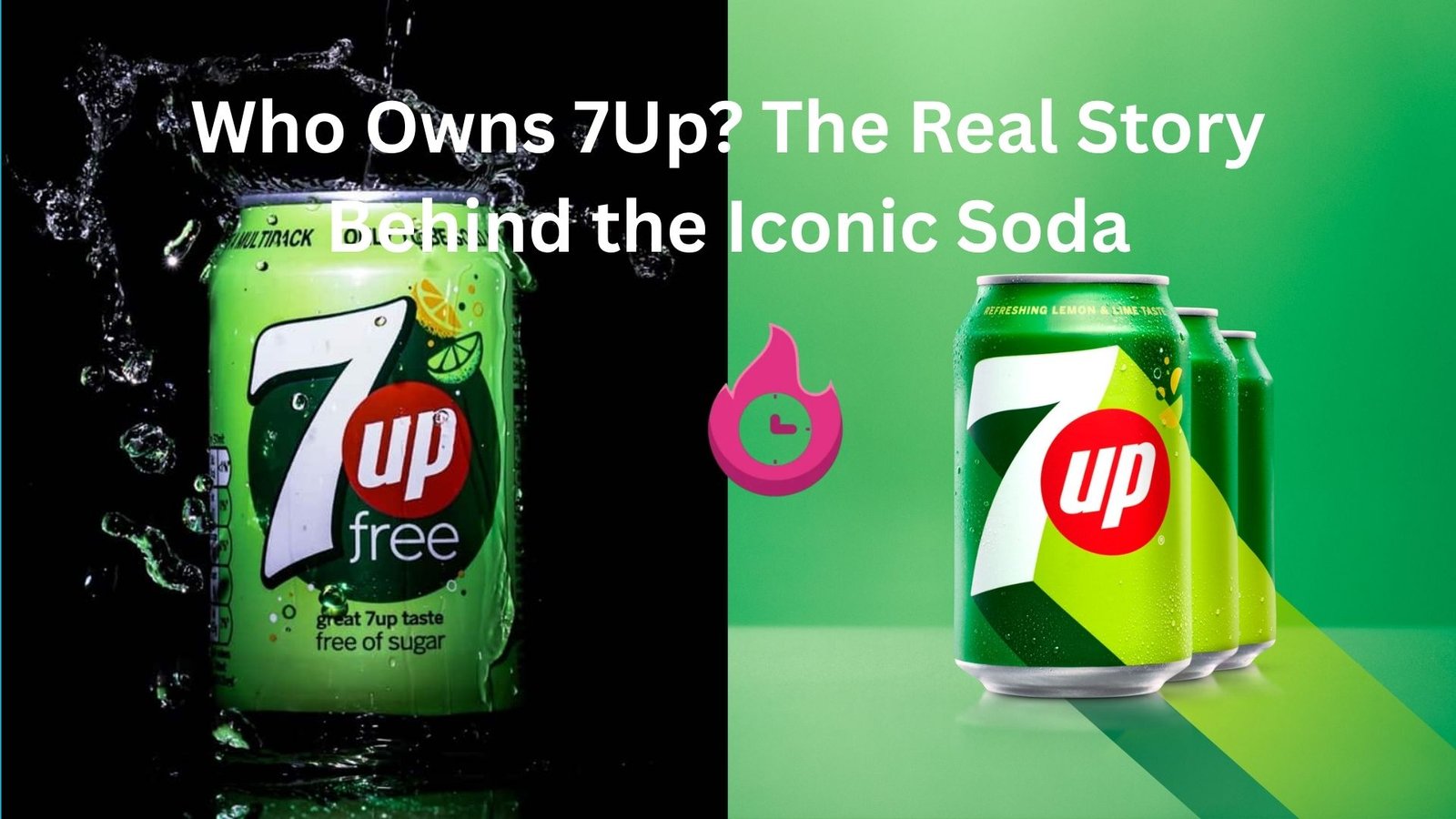
Walk into almost any grocery store in the world and you’ll spot it—that familiar green bottle with the red dot. 7Up has been around long enough to feel like it’s always been there. But who actually owns it today? The answer isn’t as straightforward as you might think, and it says a lot about how the global beverage industry really works.
Let’s unpack it.
The Short Answer (That Isn’t So Simple)
In the United States, 7Up is owned by Keurig Dr Pepper.
If you’re almost anywhere else in the world, it’s owned by PepsiCo.
Yes, the same drink has different owners depending on where you are. That alone makes 7Up a bit of an oddball in the soda world.
Now, how did that happen?
Back When 7Up Was Its Own Thing
7Up didn’t start as part of some giant beverage empire. It was created in 1929 by a man named Charles Leiper Grigg. He originally called it “Bib-Label Lithiated Lemon-Lime Soda,” which… let’s be honest, was never going to stick.
The drink actually contained lithium citrate at the time—a mood stabilizer. That sounds wild now, but back then it was marketed as something that could lift your spirits. Hence the “Up” in 7Up.
Eventually, the name got shortened, the lithium disappeared, and the brand carved out its own identity as a crisp, caffeine-free lemon-lime soda. For decades, it stood on its own, competing with the likes of Coca-Cola and Pepsi without being owned by either.
That independence didn’t last forever.
The Corporate Shuffle Begins
By the late 20th century, the soda market was getting crowded and expensive to compete in. Advertising alone could swallow entire budgets. Smaller independent brands started getting swallowed up by bigger players.
7Up changed hands multiple times. It was acquired by Philip Morris in the 1970s, which might sound odd—yes, the tobacco company. At the time, large corporations were diversifying into food and beverage to balance their portfolios.
Later, it became part of a company called Dr Pepper/Seven Up, Inc. That name should ring a bell. It’s the early version of what would eventually become Keurig Dr Pepper.
But the global story split from there.
Why 7Up Has Two Owners Today
Here’s where things get interesting.
In the 1980s and 90s, international beverage rights started getting carved up in ways that still affect what you drink today. PepsiCo acquired the international rights to 7Up, meaning they could produce and sell it outside the United States.
Meanwhile, the U.S. rights stayed with what evolved into Dr Pepper Snapple Group, now known as Keurig Dr Pepper.
So today:
- In the U.S., 7Up is controlled by Keurig Dr Pepper.
- PepsiCo controls 7Up everywhere else
That’s why a bottle of 7Up in London or Dubai is technically a PepsiCo product, while the one in a New York deli isn’t.
It’s the same brand, same general taste, but under different corporate umbrellas.
Does It Taste the Same Everywhere?
Here’s the thing—most people assume it’s identical worldwide. It’s close, but not always exactly the same.
Different regions sometimes tweak formulas slightly. It might be subtle, like sweetness levels or carbonation. Regulations, local preferences, and supply chains all play a role.
If you’ve ever traveled and thought, “This tastes a bit different,” you weren’t imagining it
It’s a bit like McDonald’s menus around the world. Same brand, slightly different experience.
Where 7Up Fits in Today’s Beverage Landscape
7Up isn’t the dominant force it once was, but it still holds a solid place—especially as a caffeine-free option. That matters more than you’d think.
Picture this: someone cutting back on caffeine, or a parent grabbing something for their kid. They’ll often reach for Sprite or 7Up. Those two have been locked in a quiet rivalry for decades.
Sprite, owned by Coca-Cola, has the bigger global presence today. It’s pushed heavily in marketing and tends to dominate younger audiences.
7Up, on the other hand, leans more into a classic, almost nostalgic identity. It doesn’t shout as loudly, but it’s still very much in the game.
Keurig Dr Pepper’s Role in the U.S.
Let’s zoom in on the U.S. side for a moment.
Keurig Dr Pepper might not have the same instant recognition as Coca-Cola or PepsiCo, but it’s a major player. Its portfolio includes a diverse range of beverages like Dr Pepper, Snapple, A&W, Canada Dry, and others.
7Up fits into that portfolio as a reliable, established brand. It’s not the star of the show, but it doesn’t need to be. It fills a specific niche: a straightforward lemon-lime soda without caffeine.
You’ll often see it bundled in promotions with other KDP brands or positioned as a safe, familiar choice.
PepsiCo’s Global Strategy With 7Up
Outside the U.S., PepsiCo treats 7Up a bit differently.
In some markets, it’s a direct competitor to Sprite. In others, it plays a supporting role alongside Pepsi’s broader lineup.
PepsiCo has experimented with branding and marketing for 7Up over the years. Some regions push it as a refreshing, clean drink. Others give it a more playful or youth-oriented image.
There have even been variations like 7Up Mojito in certain countries—a mint-lime twist that you won’t find everywhere.
That flexibility comes from having control over international rights. PepsiCo can adapt the brand depending on local tastes.
Why Split Ownership Still Exists
You might be wondering why the ownership hasn’t been unified by now. Wouldn’t it be easier if one company just owned everything?
In theory, yes. In practice, these kinds of deals are incredibly complex.
They involve decades-old contracts, regional distribution agreements, and massive financial considerations. Buying out global rights to a brand like 7Up wouldn’t be cheap, and it might not even be strategically necessary.
Both companies already benefit from the current setup. Keurig Dr Pepper gets a steady U.S. product. PepsiCo strengthens its international lineup.
Sometimes, if it’s not broken, companies don’t fix it.
A Small Real-World Moment
Think about this: you’re at a restaurant, and you ask for a lemon-lime soda. The server says, “Is 7Up okay?”
Most people don’t stop to think about who owns it. They just care that it’s cold and fizzy.
Behind that simple moment is a surprisingly tangled business story involving multiple corporations, international rights, and decades of acquisitions.
That’s the beverage industry in a nutshell. Simple on the surface, complicated underneath.
The Bigger Picture: What 7Up’s Ownership Tells Us
7Up’s split ownership isn’t just a quirky fact—it reflects how global brands evolve.
Products don’t always stay under one roof. Rights get sold, divided, and reshaped over time. What you see on the shelf is often the result of decisions made decades ago.
It also shows how competitive the soda market is. Even a well-known brand like 7Up has had to adapt, change hands, and reposition itself to stay relevant.
And yet, despite all that, it’s still here. Still recognizable. Still being poured over ice at backyard barbecues and late-night diners.
So, Who Really Owns 7Up?
The honest answer depends on where you’re standing.
In the U.S., it belongs to Keurig Dr Pepper.
Across the rest of the world, it’s part of PepsiCo.
That split might seem unusual, but it’s part of what makes 7Up’s story interesting. It’s not just a soda—it’s a snapshot of how global brands grow, shift, and survive over time.
Next time you grab a bottle, you’ll know there’s more behind it than just lemon and lime.
