



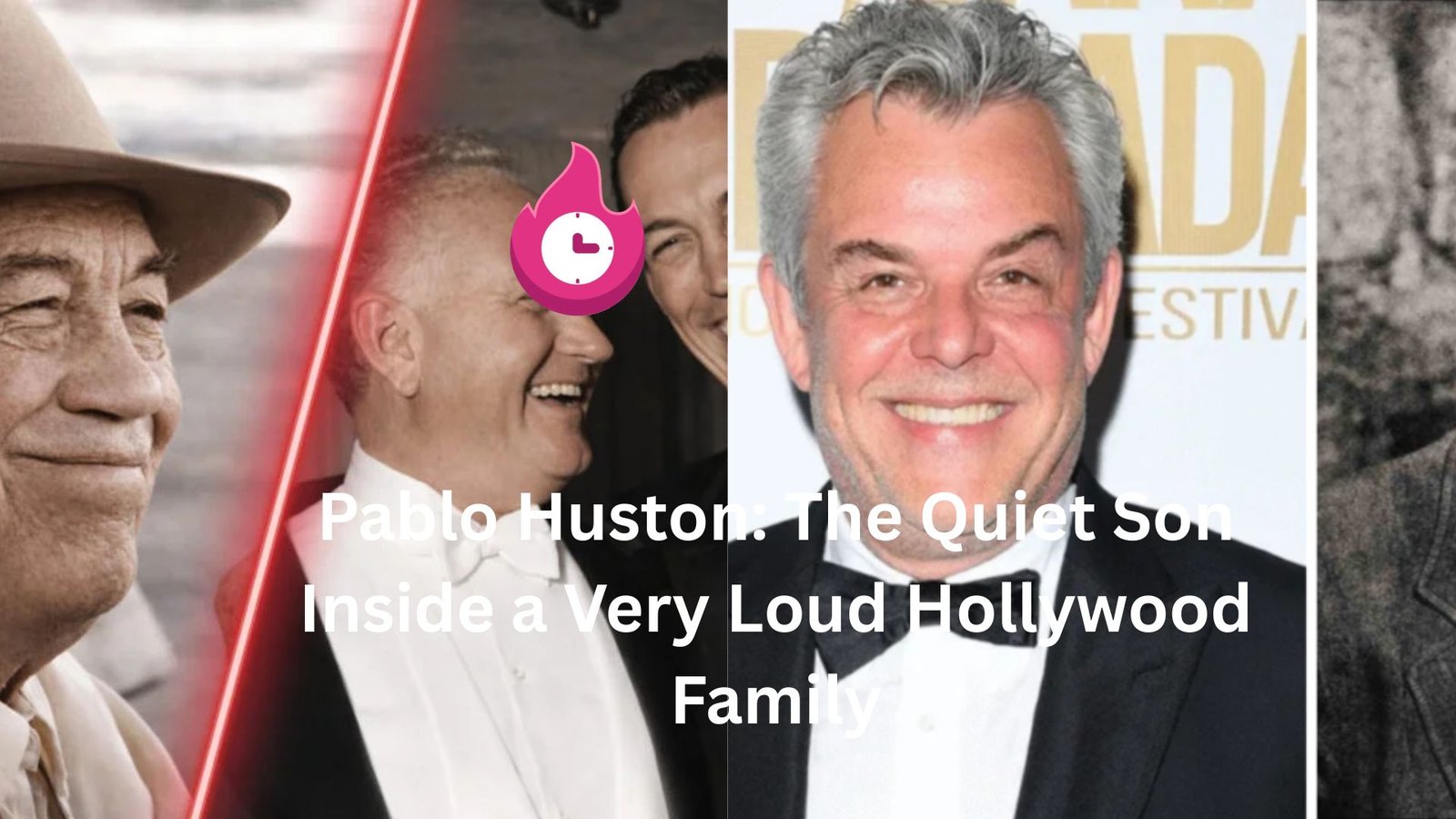
Pablo Huston is one of those names that tends to appear at the edge of a much bigger story. You’ll see him mentioned in a line about John Huston, the legendary director. Maybe in a short note about Evelyn Keyes. Sometimes in a family tree beside Anjelica Huston, Tony Huston, Danny Huston, Allegra Huston, and Jack Huston.
Then, almost as quickly, he disappears.
That’s what makes him interesting.
Not every person connected to Hollywood royalty becomes a star, a memoirist, a public character, or a regular subject of old studio gossip. Some people pass through fame without turning themselves into part of the machine. Pablo Huston seems to belong to that smaller, quieter group. He’s known mostly as the adopted son of John Huston and actress Evelyn Keyes, and the public record around him is thin, scattered, and often repeated without much fresh detail. But even that limited record opens a surprisingly human window into family, chance, celebrity, and the strange way one life can be pulled into another.
A child found during a classic film
The best-known part of Pablo Huston’s story begins in Mexico, during the making of The Treasure of the Sierra Madre. John Huston directed the 1948 film, which starred Humphrey Bogart and Walter Huston, John’s father. It became one of the great American films and won Oscars for John Huston’s direction and screenplay, as well as Walter Huston’s supporting performance.
But behind that famous production is a smaller story. While filming in Mexico, John Huston reportedly took in a Mexican boy named Pablo Albarran and adopted him. Encyclopedia.com describes Pablo as a thirteen-year-old Mexican boy whom Huston adopted during that period. Other accounts connect the adoption to John’s marriage to Evelyn Keyes, saying the couple adopted a child named Pablo while they were married.
It’s a very John Huston kind of story, honestly. Big gesture. Sudden decision. A little wild around the edges.
Imagine the scene in plain terms. A film crew is working far from the polished comfort of Hollywood. There are trucks, cables, dust, heat, actors in costume, local workers moving in and out of the production. In the middle of all that, a director known for instinct and appetite notices a boy whose life is far removed from studio contracts and Oscar campaigns. Something happens. A connection forms. A practical decision becomes a permanent family bond.
That’s the version of the story that has survived. It’s not full of neat paperwork and emotional detail. It’s more like a doorway left open.
The Huston family was never ordinary
To understand Pablo Huston, you have to understand the family he entered. The Hustons were not a calm suburban household with matching breakfast bowls and predictable weekends.
John Huston was already a major figure in film. He wrote and directed movies that helped define mid-century Hollywood. He was also known for his restless life, his marriages, his travel, his taste for risk, and his habit of making personal choices that could feel as dramatic as his movies. His marriage to Evelyn Keyes lasted from 1946 to 1950, and Pablo is generally tied to that chapter of his life.
Evelyn Keyes had her own Hollywood identity. Many people remember her as Suellen O’Hara from Gone with the Wind, but her career stretched beyond that one role. Her life, too, had its share of complicated relationships and reinventions. Classic Movie Hub notes that her marriages included John Huston and that she adopted Pablo with him.
Now picture being Pablo in that world.
One day, your life is rooted in Mexico. Then suddenly, you’re connected to a famous director and a glamorous actress. You’re not just entering a home. You’re entering a dynasty before everyone has even agreed to call it one.
There are famous dinner guests. There are film sets. There are adults who leave for locations and return with stories. There are marriages ending and new families forming. For a child, that kind of world can feel exciting, but also deeply unstable. A house full of brilliant people is still a house where a kid has to figure out where he belongs.
Pablo and the public record
Here’s the thing: Pablo Huston did not build a public career the way some members of the Huston family did.
Anjelica Huston became an Academy Award-winning actress. Danny Huston became an actor. Tony Huston worked as a screenwriter. Jack Huston, the next generation, also became an actor. The family name kept echoing through film credits for decades.
Pablo’s path is different. He’s usually described in relation to others, not through a long list of public achievements. The New Yorker, writing in 1952 about John Huston and The Red Badge of Courage, mentioned Huston speaking of his adopted son Pablo, a Mexican-Indian orphan whom he had found while making The Treasure of the Sierra Madre. Huston joked that Pablo had good taste in pictures and read Shakespeare.
That little detail matters. Not because it gives us a full portrait. It doesn’t. But it gives us a flash of Pablo as more than a footnote. A boy reading Shakespeare. A father bragging, perhaps with a little theatrical exaggeration, about his son’s intelligence. A family anecdote dropped into a conversation about movies and television.
It’s easy to overlook details like that. Yet they’re often the only places where quiet lives show up in history.
Why people still search for Pablo Huston
The renewed curiosity around Pablo Huston makes sense. People love the hidden corners of famous families. Not just the stars, but the people standing slightly off-camera.
When someone searches for Pablo Huston, they’re usually not looking for a filmography. They’re looking for context. Who was he? What happened to him? Was he close to John? Did he grow up with Anjelica? Did he stay connected to the Hustons? Why is there so little about him?
Some of those questions don’t have clear public answers. And that’s important to say plainly.
A lot of online writing about private members of famous families stretches tiny facts into big claims. It fills gaps with mood. It turns silence into mystery, then mystery into drama. That may make for a clickable headline, but it’s not fair to the person.
With Pablo Huston, the honest version is more restrained. He was adopted by John Huston and Evelyn Keyes. He was connected to the Huston family during a major period in John Huston’s life. He is mentioned as Anjelica Huston’s adopted older brother in biographical accounts. Beyond that, much of his adult life appears to have remained private.
And maybe that privacy is the point.
Living beside fame without becoming famous
There’s a particular kind of pressure that comes with being near celebrity but not choosing it for yourself.
Think of being at a restaurant with a famous parent. The waiter recognizes the last name. Someone at the next table stares a second too long. A stranger asks a question that feels too personal. You learn early that your family story belongs partly to the public, even when your own life doesn’t.
For Pablo, that must have been even more complicated because his story began with adoption across culture, country, and class. He wasn’t born into the Huston name. He was brought into it.
That distinction matters.
Adoption can be beautiful. It can also be confusing. Both things can be true at the same time. A child can gain safety, opportunity, and love while still carrying questions about origin, language, memory, and identity. Add Hollywood to that mix and the emotional math gets harder.
John Huston was not a quiet accountant coming home at six. He was a filmmaker, traveler, hunter, talker, gambler, and larger-than-life presence. People around him often described him in grand terms. That kind of father can be magnetic. He can also cast a long shadow.
Pablo seems to have lived somewhere inside that shadow without trying to make it his brand.
The Evelyn Keyes chapter
Evelyn Keyes is a key part of Pablo’s story, though she often gets less attention than John. She and John Huston married in 1946 and divorced in 1950, a short marriage by any measure, especially when a child is involved.
One old Hollywood-style account, republished by Vintage Paparazzi, presents Pablo’s bond with John and Evelyn in sentimental terms, describing them as his parents in a full emotional sense rather than mere benefactors. That wording may carry the tone of its era, but it points to something worth noticing: contemporary coverage wanted readers to see Pablo not as a charitable project, but as a son.
That’s a useful correction.
It’s too easy, especially with stories involving adoption from poverty, to frame the child as “rescued” and leave it there. Real life is more delicate. A child is not a symbol. He’s not proof of a celebrity’s kindness. He’s a person who has to wake up the next morning and live inside the decision everyone else is busy describing.
Evelyn’s role, then, shouldn’t be flattened into “John’s wife at the time.” She was part of the family arrangement Pablo entered. After the marriage ended, the family structure changed again. For a young person already adjusting to a new world, that would not have been a small thing.
The half-seen brother
Anjelica Huston’s family background is often described as complex, with siblings and half-siblings connected through John Huston’s marriages and relationships. Biographical summaries list Pablo as her adopted older brother, alongside Tony, Allegra, and Danny in the wider family story.
That phrase, “adopted older brother,” does a lot of work.
It tells us where Pablo fits on the chart. It doesn’t tell us what breakfast felt like, whether he teased the younger children, whether he loved the same movies, whether he felt at home in Ireland or California, or whether he sometimes wanted the whole famous circus to quiet down.
But families are often remembered exactly this way from the outside: names, dates, relationships, a few dramatic moments. The inner weather is harder to recover.
Maybe Pablo was comfortable being private. Maybe he found fame exhausting. Maybe he lived a perfectly ordinary life after an extraordinary beginning. The responsible answer is that we don’t fully know.
Still, his presence changes the way we see the Huston family. He reminds us that dynasties are not only made of award winners. They’re made of adopted children, stepchildren, half-siblings, ex-spouses, absent parents, nurses, houses, moves, arguments, and memories no public archive will ever completely hold.
What Pablo Huston’s story teaches us
The practical value in Pablo Huston’s story is not a tidy lesson like “follow your dreams” or “fame doesn’t matter.” Life is rarely that neat.
What his story really shows is how much can sit behind a small biographical note. “Adopted son of John Huston” sounds simple. It isn’t. Inside that phrase is Mexico, Hollywood, adoption, class, family upheaval, culture shock, privilege, privacy, and a boy trying to become himself in a house full of powerful personalities.
It also reminds us to be careful with people who appear only briefly in famous stories. Not everyone near a legend wants to become a legend too. Some lives deserve attention precisely because they resisted public packaging.
Pablo Huston may never be as widely known as John, Anjelica, or Danny Huston. That’s fine. His story still matters because it adds a human edge to a family often viewed through glamour and achievement. He was not just a detail in John Huston’s adventurous life. He was a child brought into it, shaped by it, and then, as far as the public can tell, largely protected from the glare that followed the name.
And maybe that’s the takeaway. Fame makes certain people visible, but it doesn’t make them more real than the quiet ones standing nearby. Pablo Huston’s life, partly known and partly private, is a reminder that the most interesting stories aren’t always the loudest.
